
News on developments in the research underpinning this website. See also the update history on the home page and the library index for a full list of articles. Go the About page for updates on the study and of structural changes to this website.
News Updates 2017
Oct 2017 - New Publications: Skyrmes of Manorbier and Penally, Vowchurch
Sep 2017 - From Railways to Real Estate: Llawhaden, Pennsylvania
Jul 2017 - The Vowchurch Skyrmes; Skyrme clusters
May 2017 - Kingston, Ontario; Breaking Brick Walls
Mar 2017 - Collaboration; Arthur: The Man Who Changed His Name
Jan 2017 - Richard Skyrmes of Norton Canon; Skyrmes of Manorbier
October 2017
Recent Publications and Observations
Work continues on the Skyrmes of Manorbier and Penally. In addition, as new sources come online, more data is being collected on the Herefordshire Skyrmes and also on Skyrmes who were baptised, married or died in London (mostly descendants of the Llawhaden Skyrmes).

Skyrmes of Manorbier and Penally (2nd Edition - 1st Instalment)
Since it will be some months before a complete revision the the November 2011 document will be available, I have decided to publish this document a bit at a time. This first instalment includes information on the earliest generations and also those who worked for the Great Western Railway (on ships as well as trains!). You can download it from our library here (PDF 1.1Mb).
Article on the Vowchurch Skyrmes
I mentioned below ((July news) about an article I had written on the Skyrmes of Vowchurch. This has now been published in the Newsletter of The Golden Valley Study Group. It is available here as a 10 page PDF download (1.1Mb).

What Is This?
During a recent walk in the Hambleden Valley near Marlow in Buckinghamshire I came accross this sign at the side of the road as we were entering a small hamlet. Is it an instruction or the name of the hamlet?
Click on the image and all will be revealed!
Incidentally. Hambleden is one of the locations where scenes for the TV series 'Midsomer Murders' were filmed.
September 2017
From Railways to Real Estate
In a One-Name study, unlike a family history, in when you stumble on other namesakes outside of the pedigree you are studying, you can't but help but collect more information, and possibly get side-tracked into further analysis. Although I'm currently focussing on updating The Skyrmes of Manorbier and Penally, one of side tracks that keeps intruding is information relating to the Skyrmes of Llawhaden.
Llawhaden House
I've recently returned from a 3G (3 generations, myself and wife, 3 children and spouses, 6 grandchildren) family holiday at the Bluestone resort in South Pembrokeshire. Just a few miles away is Llawhaden, the location of the family seat of the branch of the Skyrmes who came from Lugwardine (Herefordshire) via Ludlow (Shropshire). This was a family, initially of wealthy lawyers, who held prominent positions in Pembrokeshire (including the Sheriff of the County) and who also married into landed gentry (the Phillips's of Picton Castle).
While this branch of the Skyrmes is believed to have died out in the early 19th century, the family seat, Llawhaden House, lived on - at least until May 2000. Unfortunately, it was then gutted by a fire. There is an aerial photograph showing the extent of the house and damage in The Western Mail of 27 September 2006, where it was suggested that it might be rebuilt into holiday accommodation. This did not materialise and it was sold a few years later. Today, it is still a ruins, though there are signs that something may be about to happen.
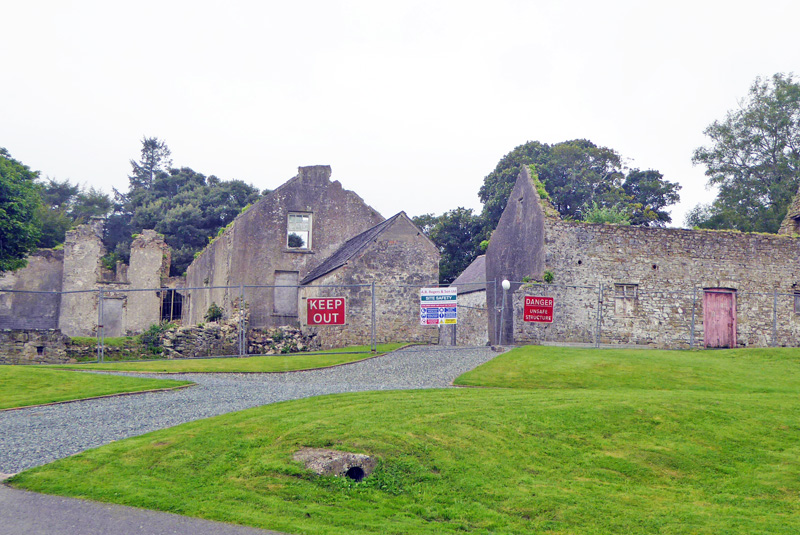
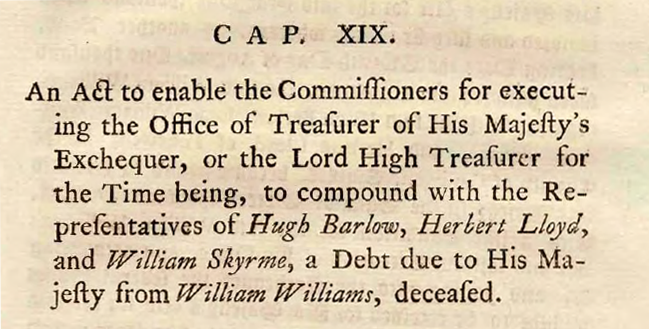
Over the last few years, I've collected a lot of information on this branch of the family, including copies of wills, work by other (now deceased) researchers, but it is not a priority to write up, since it is quite well covered in The Llawhaden Book by Mary Houseman. But just looking at what I have there are some interesting gems such as an original print of the six pages of an Act of Parliament 1774. The image shows the heading of this text.
Some Skyrmes of Pennsylvania (Munhall)
Back on the main track - the Skyrmes of Manorbier, the most recent branch I have been tracking are the descendants of William Skyrme (1838-1914) and Margaret Griffiths. William was born in Penally and Margaret in Manobier. They moved to Castlemartin between 1861 and 1862. But the spelling of their surname in records varies. In 1861 it was Skyrm, in 1871 Skyrms and 1881 Skyrmes. My own ancestor in a collateral branch spelt his name Skyrmes in the mid 19th century before dropping the s. One of their seven children was Alfred Skyrmes born in Oct 1862 in Castlemartin. Like many Pembrokeshire Skyrmes he moved east to the coalfields of the South Wales Valleys. In 1886 he was a railway fireman in Blaenllechau, Glamorgan when he married Jane Griffiths of Merthyr Tydfil. I've yet to find a blood relationship between Jane and mother-in-law Margaret. From USA arrival cards, we know that Jane's mother was Elizabeth Oram (presumably renamed after a second or third marriage) and that she had emigrated to Pennsylvania in 1891. Alfred and Jane had four children (3 boys and a girl) born between 1888 and 1894 after which they emigrated to the USA in August 1895, initially staying with Jane's mother at Edwardsville, Luzerne County. They then had five more children (1 boy and 4 girls) born in Pennsylvania. The family settled in Homestead, a suburb of Pittsburgh.
After they moved to the USA, they changed the spelling of their name to Skyrmes. During the first half of the 20th century various family members moved around Homestead and the adjacent township Munhall quite a bit (addresses include Doyle Avenue, McWhinney Avenue, Marion Street, 13th Avenue). Alfred's eldest son Albert was initially a salesman for a rubber plant but in the 1920s turned to real estate. The name Griffiths recurred (without the s) in the middle name of Albert and Selina Llewelyn's second son William Griffith Skyrmes. William had a brief marriage to Dorothy Brown but married Eleanor (Betty) Matson of Swedish descent in 1949, after which they had two children Signe and Robert.
If you look at Google maps for Munhall today, what jumps out at you is Skyrmes Insurance Agency Inc at 3909 Main Street, not far from 3121 Main Street where Albert, Selena and their sons William and Stanley lived in 1940. The insurance business was obviously a spin-off and part of the real estate business, carried on by descendants of William and Margaret Griffiths who remained in Castlemartin. Robert (1941-2010) was the third generation in the business. The company website boasts "a fourth generation insurance agency, has provided the personal and business insurance needs of Pittsburgh and all of Pennsylvania since it was founded in 1933." As an aside, it's good that our two branches of descendants (from John Skyrm and Elizabeth Maurice of Ludchurch) spelt their names differently so that we can each have our surnames as top level domain names (skyrme.com and skyrmes.com).
Other family members worked in the steel industry around Pittsburgh, and were in the area at the same time that Skyrm families, descendants of the Vowchurch, Hereford Skyrmes were also there. So Pennsylvania was a pull for several distinct branches of the Skyrmes of England and Wales.
July 2017
I've been working on two fronts during the last two months. First I've been updating the trees for the Pembrokeshire Skyrmes of Manorbier and Penally to inform the new edition of this publication which is currently being updated. Secondly, I am still working through the Vowchurch Skyrmes, using information sent by informants as well as tapping into newer online resources.
The Vowchurch Skyrmes
As part of my ongoing work I have done some analyses as well as constructing 'trees'. If you look for Skyrmes in 19th century censuses you find several clusters in different localities - Norton Canon, Sarnesfield etc. However, in sheer numbers, no single place can match the number of Skyrme families and individuals in Vowchurch. Throughout the century it had at least twice the number of Skyrme households as any other locality.
Almost all of the Vowchurch Skyrmes descend from two families - Samuel Skyrme (1752-1822) m. Margaret Seaborne (1754-1830) and that of James Skyrme (1757-1829) m. Eleanor Seabourne (1759-1809). Their brother Benjamin Skyrme (b1844), like them was born in Vowchurch but moved to Madley. Some of his descendants later moved back to Vowchurch. Over the next four generations I have found 43 descendants of Samuel and 151 of James.
But where did the Vowchurch Skyrme's come from? That's a question that I address in an article I have just written, which is due to be published shortly in the Newsletter of The Golden Valley Study Group and which is now available as 10 page PDF download). Below is a chart from the article that analyses Herefordshire baptisms, covering localities where there were the most Skyrme baptisms in any 25 year period (1525-49 and so on).

Connecting the Clusters
One of the challenges of a One-Name Study is to build family trees from all the many instances of the name that are found. What starts as a cluster of individuals in one locality, can ultimately be formed into a branch of a tree. With a bit of investigation, and often luck, clusters at two localities can sometimes be joined. Thus what started as two clusters in Norton Canon is now one, and in turn what was a separate cluster in Kinnersley and Sarnesfield is now part of the Norton Canon cluster. Censuses are the easiest way to join separate clusters, since a census in one locality may well record an individual as being born in another. Where censuses cannot help (e.g. pre-1851) sometimes marriage records give an indication of movement from one village to another. For example, the marriage record of Thomas Skyrme of Pencombe says "Thomas of Brimfield".
But taking a wider geographic perspective there are several important clusters that have not yet been connected:
- Three Pembrokeshire clusters - Llangwm, Llawhaden and Manorbier. No common ancestors have been found with any certainty.
- The Manorbier Skyrmes and Herefordshire. There is a clue in that the furthest common ancestor was married in Ludchurch and the 1841 census gives his birthplace as "not in Pembrokeshire"; also a Ludchurch history identifies a Thomas Skyrme (a name found amongst the Herefordshire Skyrmes at the time) as a landowner in Ludchurch.
- The Llawhaden Skyrmes and those of Herefordshire - we know that this branch started by the move of father and son lawyers from Ludlow in the 1640s, but the Ludlow Skyrmes have yet to be connected with other Herefordshire clusters.
- The Worcester Skyrmes and Herefordshire Skyrmes - we are close to resolving this one, in that there is a Thomas, widower of Much Dewchurch, and another Thomas of Hereford St Peter.
Perhaps the most intriguing cluster is that of the Skirmes of Lincolnshire. There are references to over 80 Skirm(e)s from 1563 to 1745. Yet where did they come from and where did they go to? An intriguing possibility is that some were early settlers in the USA since there are references in the late 18th century to Skirm families in Trenton, New Jersey. As to where they came from. there are no obvious clues. They could have come from Lugwardine where there were Skirmes at the same time. But we must not overlook the possibility that the surname had multiple places of origin, and that Lincolnshire was one of thise.
So, there's still a lot of detective work to do. With these earlier clusters, we may never get definitive answers, but just have to infer connections based on the balance of probabilities.

May 2017
Yet more Herefordshire contributions. Since my last post, I've received yet more useful inputs on the Skyrmes of Herefordshire. The work of several different contributors now overlaps so it provides a useful cross-check of information in the master database. The contributions have moved me away from the Skyrmes of Vowchurch, but still on the descendants of Richard Skyrme of Norton Canon. More on our findings in the next post.
A Spring Clean Surprise
I've been going through old file boxes and folders and scanning what I think would be useful to pass down to my descendants. While going through one folder, I came across my father RAF discharge booklet. Elsewhere I had a copy of his official RAF record. I had ordered this a few years ago direct from the RAF at a cost of £30, but now find it on Ancestry free to subscribers! But as I was scanning a newspaper cutting fell out (top part of it shown on the right).
It was about a talk my father had given to the Kiwanis Club of Kingston, Ontario (still going strong) at one of their monthly luncheon meetings. It describes his talk on the situation in India, where he had served from 1936-1938 at places like Lahore (now in Pakistan).
It was quite a timely discovery since we had already booked to see the recently released film The Last Viceroy about the events leading to independence and partition.
But what was truly amazing, is that my father left 10 thick hand-written diaries, over 300 pages in total, and in his coverage of his two years in Canada (1941-2) there was not a single mention of this talk.
So get Spring cleaning - you might find some fascinating surprises lurking in your old family box files?
Demolishing Brick Walls

I mentioned in the Nov 2016 news some useful new ways which help to overcome 'brick walls' - the new GRO indexes, the 1939 Register etc. Using examples from my Pembrokeshire study, I developed these examples into a full 7-page article for the Dyfed Family History Journal. Source covered included school admission books, monumental inscriptions, newspapers, passenger and immigration records, and different ways of searching censuses.
One example I used was a search of the GRO Probate calendar. I was searching for Thomas Nicholas, the shipwright husband of Anne Skyrme of Manorbier (1867-1929). This is what I found:

The name Sedia is unusual and struck a chord. I knew that my database had a Sedia Skyrme. She was in fact a sister-in-law of Thomas. So this was a quick way to find her spouse, first from BMD records, and then the 1939 Register to identify the right Thomas Clemens, another shipwright.
You can read the full article here (PDF: 1.05Mb). It is in our document library where you can see all the other articles on this study, including ones published in 2016-17 that have just been uploaded.

March 2017
Apologies to the Pembrokeshire Skyrmes, but in the last few months I have been concentrating on the Herefordshire Skyrmes. The main reason is that only 3 out 15 substantive enquiries over the last year have concerned the Pembrokeshire branch of the family, and that I have received several significant contributions for the Herefordshire families (see below).
Contributions and Collaboration
Some of the contributions I have received about the Herefordshire Skyrmes over the last 9 months include:
- A Family Tree Maker database of a person's ancestors who married into the Skyrmes
- A DVD video of an interview one US-based correspondent had in 2004 with a 90+ year old Skyrme
- A set of family sheets of different generations of Skyrme ancestors, including four Richard Skyrmes (see sample image right)
- A pedigree chart of the Vowhcurch Skyrmes. which when printed out was 16 A4 sheets wide and 2 deep.
- A 13-page attachment to an email covering one particular Skyrme branch.
I thank all these contributors for sharing their information. It is a painstaking process to cross-check contributions with what I have in my master database, and often there are discrepancies. So, although I have worked on the Herefordshire Skyrmes on average 10 hours a week so far this year, I am barely a third of the way through processing what I have.
One positive thing that has come out of these contributions is that it quickly becomes a collaborative exercise. Between us, we add new information, raise questions and share our new discoveries.
So although it is too early to update the Skyrmes of Herefordshire publication (PDF), the database is evolving and I am in a position to respond to queries by providing output charts, family sheets and individual overviews.
Arthur: The Man Who Changed His Name
It is somewhat disconcerting when you have a family of Skyrmes and you cannot trace back. Sometimes I just do a census search using first name, birthdate and place. This often throws up bad mistranscriptions such as Skyome, Skynne and Shyrme. But in one case we sometimes see Williams and sometimes Skyrme:
- 1851 Arthur Skyrme - Widemarsh Street, Hereford. Listed as son of James and Jane - though the entry is unclear, daughter Agnes (who did not exist) crossed out (see image)
- 1861 Arthur Williams - 36 Widemarsh Street, Hereford. Listed as nephew of James and Jane
- 1871 Arthur Williams - Blackmarstone, Hereford. Married to Annie with four Williams children
- 1881 Arthur Skyrme - St Martin's Street, Hereford. Now with six children, all named Skyrme.

The children of Arthur and his wife Annie (neé Jauncey) continued to use the name Skyrme (though five of the eight were registered as Williams). They included well known local architect Herbert William Skyrme who restored Hereford's 14th century Booth Hall Inn in 1921.
Arthur was a tailor as was James Skyrme listed as his father in the 1851 census. His baptism at St Owen Hereford in 1839 lists his mother as Mary Williams. No father's name was given.
Now it happens that James Skyrme was married to Mary's sister Jane. So we could square the circle that Arthur was indeed both the son and nephew of James if he was the result of a liaison between James and Mary. Or it could be, that his father was someone else, and that James and Jane 'adopted' him by taking him under their wing as a favour to Jane's sister Mary. DNA tests of the true Skyrmes and Williams/Skyrmes may resolve this conundrum.
This is but one example of the results of a collaborative toing and froing and sharing information.
Update 2017 - I wrote a short article based on this for Herefordiensis. You can download the article from our library here (PDF: 0.35Mb).
January 2017

While many of our ancestors were 'ag labs', others were higher up the income scale as farmers. We know that many of the Herefordshire Skyrmes were farmers (see Oct 2014 news on their contribution to the Hereford cattle breed), and I thought it instructive to compare the relative wealth of the branch mentioned in November (below) with a Pembrokeshire branch.
The Richard Skyrmes from Norton Canon
This branch had many large families (8-12 children) but the eldest son was always called Richard. We find a reference in a baptism certificate that Richard (1718-1798) was a farmer at Norton Canon. The will of his eldest son Richard (1764-1838) shows how his estate is to be divided between his ten living children, giving the names of specific fields and hopyards. All six of his sons became farmers. Below is a table of the size of holdings and the value of estates at time of death (where known from probate records) of eldest son Richard (1791-1876), whose wife was Ann Jones and four of their sons (great grandsons of our earliest known farmer Richard).
| Name | Location | Farm | Estate |
|---|---|---|---|
| Richard (1791-1876) | Kinnersley & Sarnesfield | 308 acres 250 acres employing 3 men/2 boys | £250-400 |
| Richard (1821-1894) | Canon Pyon | 20 acres | £24 |
| George (1826-1889) | Logaston, Almeley | 36 acres | |
| Thomas Jenkins (1837-1907) | Kinnersley | 140 acres, 3 labourers | £1,624 |
| Joseph (1839-1923) | Kings Pyon | 182 acres | £1,755 |
So the eldest son was not always the wealthiest! Two things struck me as I researched this branch of farming Skyrmes: 1) Most of the girls married farmers, sometimes in neighbouring counties, e.g. in Radnorshire; and 2) There were several Skyrme-Skyrme marriages, of first or second cousins.
Skyrmes of Manorbier
In my History of the The Skyrmes of Manorbier I noted that while my branch were mostly shipwrights, that at least three of the four sons of John Skyrm (born around 1749 and probably in Herefordshire) and Elizabeth Maurice were farmers. The table below shows information about second son John and his son Joseph and three of Joseph's sons (another of Joseph's sons, John, became a shipwright).
| Name | Location | Farm | Estate |
|---|---|---|---|
| John (1778-1856) | Manorbier, Green Grove* | 27 acres | |
| Joseph (1805-1882) | Manorbier | 3 acres then inherited Greengrove 27 acres | £145 |
| Thomas (1841-1916) | Manorbier | briefly a farmer, then a haulier and salesman in Pontypool | |
| James (1847-1931) | Manorbier Later Lower Sapey, Worcs | 95 acres | |
| Francis (1850-1922) | Wolferlow, Herefordshire |
* Greengrove is still a working farm today (see July 2013 news)

Joseph's elder sister Elizabeth (b1803) married farmer Lewis Griffiths who farmed 40 acres at Eastmoor, Manorbier. His younger brother John remained single and worked on the farm at Greengrove. Joseph married into the Beddow (Beddoe) family, some of whom were farmers. Joseph had five sons, but only the three shown above were farmers.

When I visited Pembrokeshire Archives in 2015, I pored over the Manorbier and Penally tithe maps, looking for references to Skyrme. Today, such a visit is unnecessary, thanks to the Cynefin project (click on the image above to visit). With over 1,100 volunteers it is in the process of repairing and digitising around 1,200 tithe maps and transcribing over 30,000 pages of index documents. Most of the maps and associated schedules have been scanned and indexing is well under way. Browsing through the Manorbier schedule I came across six entries for John as an occupier including Shipping Park, Water Park and Cousins Breadth. In total the acreage was nearly 54 acres. The landowner was Thomas Cadwallader Esq. Several Skyrmes married into the Cadwallader family, including John himself who married Ann Cadwallader. In Penally I noticed several plots with the name David Beddoe, another farmer, and the father-in-law of James. There were several other locations in Skyrme occupation, including a house and three fields/meadows by Mary Skyrme, amounting to 11 acres. I have yet to place Mary.
So as with every new source that comes online, some new facts and answers come to the fore, but more questions are posed.