

News on developments in the research underpinning this website. See also the update history on the home page and the library index for a full list of articles. Go the About page for updates on the study and of structural changes to this website.
News Updates 2024-26
Aug 2026 - 200,150 and 200 years go: The Worcester hosier; the infamous solicitor of Ross; heirs wanted and the Mayfair hostess
Sep 2025 - Great Western, Great Stories: Evan Skyrmes, brakesman, David Skyrme, stationmaster
Mar 2024 - A Yorkshire Connection: Robert Henry Skyrme at Selby
August 2026
It’s a while since I posted. This is mainly because rather than focussing on one group of families, I’ve just been updating facts all over the Skyrme lines as new material comes online. For this post I’ve therefore reverted to what I’ve done before, by looking at newspaper stories 200, 150 and 100 years ago covering the months January to June.
200 Years ago – From Mother to Son
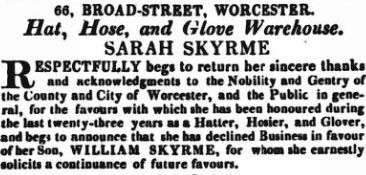 In April 1826 there was a handover of a hosiery business from mother to son. There Worcester Journal had two adjoining adverts relating to a Hat, Hose and Glove Warehouse of 66 Broad Street.
The first advert was from Sarah Smith who “respectfully begs to return her sincere thanks and acknowledgements to the Nobility and Gentry of the County and City of Worcester, and the Public in General for the favours in which has been honoured during the last twenty three years...”.
She then wanted these favours to be extended to her son William who was taking over the business.
In April 1826 there was a handover of a hosiery business from mother to son. There Worcester Journal had two adjoining adverts relating to a Hat, Hose and Glove Warehouse of 66 Broad Street.
The first advert was from Sarah Smith who “respectfully begs to return her sincere thanks and acknowledgements to the Nobility and Gentry of the County and City of Worcester, and the Public in General for the favours in which has been honoured during the last twenty three years...”.
She then wanted these favours to be extended to her son William who was taking over the business.
In his advert William announces a one week closure "in order to make the necessary arrangements" and that the shop will reopen on Saturday 22nd April “with an entire New and Fashionable Assortment of LONDON HATS, HOSIERY and GLOVES”.
Sarah née Barwell was the wife of Thomas Skyrme (1758-1814), glover and hosier who we introduced in the news for March 2019. A record of the freemen of the city dated October 1812 shows that their fifth son William was "admitted and sworn a Citizen of this City as the Apprentice of his father, Thomas Skyme, Hosier.” William later married but only had one son Edward who was first a chemist and then ran two pubs, one at the racecourse where he was heavily involved in ace meetings, e.g. as a starter. This family features in several earlier news items, e.g. The Worcestershire Skyrmes (Oct 2018), Edward’s Energetic Exertions (Feb 2019) and Thomas Skyrme advertises his wares Mar 2019).
150 Years Ago - The Infamous Solicitor
The most significant happening was a High Court Case claim by a builder against the estate of J H Skyrme of Ross. I've written elsewhere about this infamous solicitor John Henry Skyrme. Holding a respectable place in society and the holder of several pubic officers, it turned out after his death that he was something of a fraudster – see my article The Infamous Solicitor of Ross. Although court cases rumbled on in the year or so after his death in April 1873, this particular court case only started in March 1873. John was something of a developer – in fact he owned over 200 acres of land in 1873. Builder J.B. Kemp of Ross was commissioned by John to build a villa for himself called Allen Grove at Ashfield, a suburb of Ross-on-Wye. Payments started on account in July 1869 and there was a final account in March 1871: “To building villa at Ashfield complete £1,700.” There was an understanding that John would “take it off the builders hands” at cost price.
However, after John died, the builder assessed that with other items the total cost of the villa was £3,790. He sent in an account to John’s executors, even though he was still in possession of the building and trying to find tenants. There were also four other defendants in this convoluted case that also involved a mortgage and a person who claims to have bought the property from John, although the sale was not completed. After hearing from counsel the judge decided that Kemp had “no interest in the property” relying on a parchment title for his ownership rather than a substantive title.
100 Years Ago - Heirs Wanted and the Mayfair Hostess
Two Skyrme stories dominated the press in the first part of 1926. The first was the search of heirs of William Skyrme who made a fortune his mining career in the USA (Utah, California, Montana and Nevada) and South America. He died in San Francisco and left an estate could have been as much as a quarter of a million pounds. As well a call for heirs in The People of 13 June 1926 that suggest Swansea and Portsmouth families night be heirs, the Nottingham Journal of 21 June indicated that Godrey Skyrme a Long Eaton lacemaker believed he was a cousin. But as I noted in my March 2022 news item, I identified William as a descendant of the Llangwm Skyrmes. As such he would have had several heirs, but not Godfrey since he was descended from the farming Skyrmes of Norton Cannon (see Jan 2017 news and also my article Have I Finally Struck Gold? However, the gold still eludes me since I have I’ve yet to find if anyone was successful in making a claim.
The other person hitting the headlines was Trixie Skyrme, born as Theresa Skyrme in 1899 at Wellington in Herefordshire. She reinvented herself as society girl Josephine O’Dare and made many headlines. Some of those in the first part of 1926 included:
- "O’Dare’s Dramatic Denials: Mayfair Hostess and the Secret of her Birth" - she claims she was born of British parent in Shanghai in 1902! She denied her name was Skyrme or that she had used the name Mrs Houghton when living at Barton Manor in Hereford.
- “Derby Hope of a Woman: No Light on a ‘Dark’ Horse” – she is photographed with a horse and claimed that with him she could be the youngest owner of a Derby winner the following year. At the time there was a petition for bankruptcy against her. She said “No one can be allowed to see my Derby winner yet. Wait until my troubles have blown over and then I’ll invite you down to my estate and you can see as much as you chose of him.” She refused to reveal where her estate was!
- “Josephine O’Dare’s Mysterious Past” – she admitted that earlier she was known as Trixie Skyrme but still insisted that she was born 12 miles from Shanghai.
- “My Life and My Lovers” by Josephine O’Dare. One of these was William George Davis, and expert forger who was sentenced to 10 years imprisonment.
Another article in The People “O’Dare’s Dream Racehorse” starts “In telling the story of Josephine O;’Dare’s astonishing climb to social success and her equally amazing fall I have followed the example of the Roman nobility who withheld their most delectable treats until the end of the entertainment”. The article talks about her racehorse being trained in Ireland and gives an insight into “this queen of female criminals”.
A lot more has been written about her over the years. I’ve written a bit about her in The Herefordshire Skyrmes (pp26-7) and Jennifer Green has written a fictional account based on facts in her book Whatever happened to Trixie Skyrme?. When she was sentenced for deception and conspiracy at the Old Bailey in 1927 the judge said “London Society is rid of one of the most remarkable and dangerous women of this or any other century”.
These 1926 newspaper articles give just a glimpse into the world of this deceptive character.
September 2025
Great Western, Great Stories
Apologies - I had planned to update this page at least once a a quarter but I see that it's been 18 months since my last post. I have not been idle. Looking at my database I see that I have updated over 1,200 individual records since then. Most updates are the results of new information coming online particularly more images of parish records and the British Newspaper archive, where the number of articles mentioning Skyrme or Skyrm is now over 40,000. Newspapers.com has also provided me with a lot of new information on the USA Skyrm(e)s, particulary the miner William Skyrme (scroll down to the news for Mar 2019 and Mar 2022).
So there's lots of good stories to tell, and I'll try to be more frequent in posting in the future. But for this post I'll draw from some of my research into Skyrmes who worked for the Great Western Railway (GWR) which I used for a recently published article 'Great Western - Trains and Boats and Planes', Dyfed FHS Journal (Aug 2025) and which will shortly be uploaded to the library section of this website)
Evan Skyrmes, brakesman
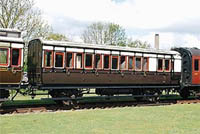
A brakesman is a guard. He would have worked on a brake passenger van of the type now found at Didcot Railway Centre. Evan (1864-1928) was one of six sons of William Skyrme and Margaret Griffiths. Thugh early records gives his surname as Skyrmes, he had regularised it to Skyrme like the rest of his family by 1911. Originally from Manorbier they moved to Castlemartin in 1861. Evan's older brother Alfred (1862-2945) had joined GWR as a fireman in the mid-1880s. A few years later Evan also joined GWR. He was a foreman porter at Ferndale on the Taff Vale line in 1889. There are several records mentioing him on the GWR staff registers now on Ancestry. He a porter at Penrath and Maerdy, then in 1902 he became a brrakesman first at Cardiff, then Merthyr Tydfil and then back at Meardy. His wages started at 3/6 (3s 6d) a week and peaked at 87/6 a week in October 1920. The last entry shows he earned 65/- a week in July 1922.
He features in several newspaper articles, mostly as giving evidence for fare dodgers. However he hit the headlines of The Western Mail of 18th May 1894 which reads: “Attempted Murder at Ferndale”. The story goes onto say:
"John Bufton, a railway porter, was in custody before Cymmer magistrates charged with attempting to murder another porter Evan Skyrme at Ferndale railway station.. Bufton rushed upon Skyrme with an open knife, with which he tried to stab him, saying, "I will murder you, and then throw myself under the train." With difficulty Skyrme got away from the would-be murderer, and lodged a complaint with the police, who forthwith arrested him."
The sentece for Bufton was two sureties of £50, or failing that, 3 month's prison with hard labour.
David John Skyrme, stationmaster
David (1865-1936) was a third cousin of Evan and the eldest son of cabinet maker James Skyrme and Martha Richards, originally from Penally but who had moved to Pembroke Dock just before David was born. originally started work as an apprentice in his father's trade. But in October 1881, age 15, he became a railway lad clerk at New Milford (one of the termini of the Great Western in Pembrokeshire) at a salary of £20 per annum. By 1884 his salary had doubled to £40. By 1891 he was based in Corwen in North Wales (then in Merionethshire) as a railway goods clerk. In February 1901 David was appointed stationmaster at Albrighton, a station on the GWR line from Paddington to Birkenhead via Birmingham Snow Hill. He later served at Bala, Dolgelly and Chester. He was stationmaster at Ruabon until his retirment in 1925. After that he and hise wife Sarah moved to the Curzon Park area of Chester where he died.
Summary
A combination of GWR ecords and newspaper articles can give you more insights into the lives of your railway ancestors. I've just picked out a couple of Skyrmes. You can find out about some more Skyrme railwaymen in chapter 7 of the evolving Skyrmes of Pembrokeshire - Manorbier and Penally V2.
March 2024
A Yorkshire Connection
I covered the topic of migration in the last post (Nov 2023). With the advent of the railways in the mid-1800s, our ancestors were not as rooted in one place as they were in earlier generations. Skyrmes who originated in Herefordshire and Pembrokeshire are found in many places across the world. The major mining and manufacturing cities were common destinations, but there are some places where the reason for moving there are not obvious. One migration that intrigued me was a move from Pembroke Dock to North Yorkshire via London. Here is this person's story.
Robert Henry Skyrme (1864-1951)
On page 24 of the The Skyrmes of Llangwm I mentioned the family of Peter Skyrme (1837-1892) and his wife Frances (née Mason). Peter was a shipwright, and five of his six sons also worked in shipbuilding trades. The exception was Robert Henry. He was born in Gillingham, Kent in 1864 since it seems that Peter had moved to Chatham Dockyard for a few years. The family moved back to Church Street, Pembroke Dock where Peter and Frances lived for the rest of their lives.
Son Robert started off similar to his brothers being a joiner’s apprentice in 1881. However, he obviously decided that shipbuilding was not a career for himself, so at age 22 we find him joining the Metropolitan Police in May 1877 and living in Westminster. His record shows that unlike many Skyrmes he was tall - 6ft 1½ ins. Just a few month’s later he married Alice Drew from Portsmouth. How come? Just like one of my great grandfathers, the Metropolitan Police were responsible for policing the country's Royal Navy Dockyards wherever they were located. And since Alice’s father was a clerk at Portsmouth Dockyard, it’s possible that Robert was initially posted there. The couple's first child Robert Henry junior was born at Portsmouth in 1888, but the 1891 census sees the family in Westminster. It’s possible that Robert senior was there most of the time, and that Alice moved to her parents when Robert junior was due. From Westminster the family moved to Regent’s Park where one of Robert’s cousins was a zoo keeper.
The Move North
After well over a decade in London, the interesting move was in the early 1900s when the family moved to Barlby near Selby, Yorkshire. In all my research, I’ve only found a handful of other Skyrme families who moved to Yorkshire. But why did Robert and family move there when he was still in the Metropolitan Police? The answer was that it was the site of a War Department ordnance depot. And like the dockyards, responsibility for policing was with the Metropolitan Police. Following munitions supplies problems during the Crimean War the depot was built in 1889 and had a gunpowder store and several other buildings. The site was still used until the 1970s, still policed by the Met.
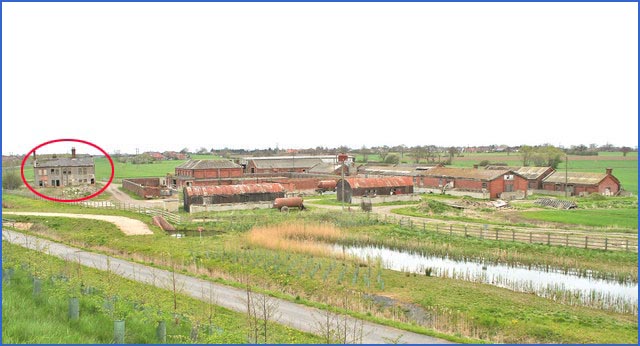
The photo above (taken in 2006) is © Copyright Gordon Kneale Brooke and licensed for reuse under this Creative Commons Licence). The depot itself is now a listed building (https://historicengland.org.uk/listing/the-list/list-entry/1457135) and other buildings site are somewhat derelict – see more photos at https://www.derelictplaces.co.uk/threads/barbly-munitions-yorkshire-july-2021.39167/ and https://www.28dayslater.co.uk/threads/former-war-department-munitions-depot-barlby-yorkshire-june-2021.129240/. During the time that Robert worked there, the family lived in one of the three police houses on the site (circled in the photo).
With the recent uploading of North Yorkshire electoral registers on Ancestry, I’ve been able to trace the family movements. Robert left the police in May 1913 and therefore had to move out of the tied house. Robert moved first to Selby, and then to Leeds where he was at four different addresses until he died in 1951 aged 87. For some of that time his son and his family lived with him. For example, in 1939, there were three generations of Robert living together in Bramley, Leeds. Robert junior had married Edith Daniel in Leeds in 1912. They had a son Robert Daniel born 1914. Robert Henry junior served as a gunner in the Royal Artillery in WW1 and later became a clerk for the LNER railway. Like his father, he too reached the age of 87, dying at Southend in 1976 which is where his son Robert Daniel then lived.
I always find it facinating to follow the moves of Skyrmes around the world. All the above is based on publicly available sources, but if Robert has any surviving relatives who read this, then I would be pleased to hear from them.